Nature-Inspired Engagement Rings
What defines a nature-inspired engagement ring?
A nature-inspired engagement ring is characterised by design elements borrowed directly from the natural world: leaves, vines, florals, branches, and organic asymmetry replace the clean geometric lines found in classic solitaire or art-deco settings. The defining quality is a sense of growth rather than construction — shoulders that taper like stems, galleries carved with trailing foliage, or claws shaped as petals that hold the centre stone as a bloom rather than a mechanical grip.
Nature-inspired rings have a long precedent in fine jewellery. Victorian and Edwardian pieces drew heavily on botanical illustration, and many of today's designs revisit that language using contemporary CAD precision to achieve detail — such as individually textured veining on leaf claws — that hand-engraving alone could not reliably replicate. The result sits between antique sensibility and modern manufacture. Wearers are often drawn to the way nature motifs feel personal and narrative without requiring initials or stones tied to a birthdate.
Which centre stones and metals suit nature-inspired settings?
Nature-inspired settings work with almost any centre stone shape, though oval, pear, and round cuts are most frequently chosen because their curved outlines echo the organic forms already present in the band. An oval stone resting in a leaf-claw setting reads as a single cohesive botanical element; a pear stone held in a petal mount reinforces the floral analogy. Cushion cuts also complement the softness of vine-work shoulders, while marquise stones — elongated and pointed — suit branch or thorn motifs particularly well.
For metal, nature-inspired rings are produced in platinum or gold — available in 9ct, 14ct and 18ct across yellow, white, and rose gold depending on the design. Rose gold is widely requested because its warm tone mirrors autumn foliage and aged bronze botanical specimens. Yellow gold references earlier Victorian naturalist jewellery directly. White gold or platinum provides contrast that foregrounds the carved or textured detail rather than blending into it — useful when the metalwork itself is intricate. The choice is also practical: platinum's density gives durability to fine filigree-style details that might thin over years in lower-karat gold.
What does a nature-inspired engagement ring cost in the UK?
The cost of a nature-inspired engagement ring in the UK depends on the complexity of the metalwork, the metal chosen, and the centre stone's carat weight, cut quality, and origin. Bridebook's 2026 UK average engagement ring spend of £2,247 offers a useful reference point, and a well-specified nature-inspired ring — a leafwork band set with a 0.5ct certified diamond — sits comfortably within reach of that figure.
Intricate nature-inspired designs do carry a small premium over plain-shank equivalents at the same stone grade, because the additional metalwork — carved veining, sculpted petal claws, engraved vine shoulders — requires more time in CAD design, casting, and hand-finishing. Choosing a lab-grown centre stone at the same carat and cut specification as a natural stone reduces the stone cost and may free budget for more elaborate metalwork detail. The reverse is also a considered choice: a simpler leaf-claw setting allows investment in a higher-grade natural diamond. Both approaches are available; neither is framed as preferable.
How are nature-inspired rings made to order, and how long does it take?
Every nature-inspired engagement ring begins with a consultation to establish the specific motifs, stone shape, metal, and scale that suit the wearer. From that conversation, our Hatton Garden team produces a full CAD design that maps the botanical detail precisely — petal proportions, vine curvature, and shoulder texture are all resolved at this stage before any metal is committed.
A silver or wax sample is then produced and available for a try-on appointment at our Hatton Garden showroom, allowing the fit, scale, and overall balance of the nature-inspired design to be assessed before casting begins. From order confirmation, production runs to 7-14 working days — simpler designs such as a leaf-claw solitaire are completed toward the shorter end; heavily carved or multi-element botanical bands sit at the longer end. Every finished ring is hallmarked at the London Assay Office and delivered by insured UK courier at no additional charge. Resizing is free for life.
Caring for a nature-inspired ring day to day
Nature-inspired rings with carved or textured metalwork — leaf veining, vine scrollwork, granulation — require slightly more attentive cleaning than a plain-shank ring because organic motifs create recesses where soap film and debris accumulate. A soft-bristle brush with warm water and a small amount of mild detergent, worked gently into the carved detail, is sufficient for regular maintenance at home.
Platinum and higher-karat gold settings are well suited to daily wear, but nature-inspired designs with very fine filigree-style elements benefit from occasional professional inspection — particularly at the claw tips if petal or leaf claws are used, as these can flex over time. President Jewellers' lifetime warranty covers the structural integrity of every ring. Pairing a nature-inspired engagement ring with a plain or lightly textured wedding band prevents the two pieces from wearing against each other's detail; a flat court or slight court wedding ring in the same metal is the most frequently chosen complement.
Frequently asked questions
What is a nature-inspired engagement ring?
A nature-inspired engagement ring is one whose design vocabulary draws from the natural world — leaves, vines, petals, branches, or organic textures worked into the band, claws, or gallery. Rather than the clean geometry of classic or contemporary settings, the metalwork reads as grown or botanical. The style spans a wide range, from a single leaf-motif claw to an intricately carved full-vine band.
Which stone shapes work best in nature-inspired designs?
Oval, pear, and round centre stones are the most frequently chosen for nature-inspired settings because their curved outlines echo the organic forms of petal claws and leaf galleries. Marquise stones suit branch or thorn motifs particularly well. Cushion cuts complement softer vine-work shoulders. Geometric shapes such as emerald or Asscher cuts can be used but introduce a deliberate tension between the angular stone and the organic setting.
Can I choose a coloured gemstone in a nature-inspired ring?
Yes. Nature-inspired settings are frequently paired with coloured gemstones — sapphires, rubies, emeralds, and morganites are all popular choices — as the botanical aesthetic reinforces the earthen, mineral quality of coloured stones. A green tourmaline in a leaf-claw setting or a deep blue sapphire resting in a petal mount both read as cohesive design choices rather than unconventional ones.
How is a nature-inspired ring different from a vintage-style ring?
Vintage-style rings reference specific historical periods — Edwardian filigree, Art Deco geometry, Victorian cluster formats — through period-accurate design codes. Nature-inspired rings borrow from botanical forms that appear across multiple periods and are not bound to a particular decade. A nature-inspired ring may have a vintage character if it uses Edwardian-style foliate motifs, but it may equally feel contemporary if the leaf forms are abstracted or simplified.
Are nature-inspired rings available in lab-grown diamond options?
Yes. Every nature-inspired engagement ring can be configured with a lab-grown or natural diamond as the centre stone — both are certified to the same standards by GIA, HRD, or IGI. Lab-grown diamonds offer the same optical and physical properties as natural diamonds at a lower per-carat cost, which can allow a larger or higher-grade stone within a given budget, or redirect budget toward more intricate botanical metalwork.
Featured nature-inspired engagement rings
Hand-selected pieces from the President Jewellers catalogue

Willow Ring With Sapphire Accents Engagement Ring
£1,221.08
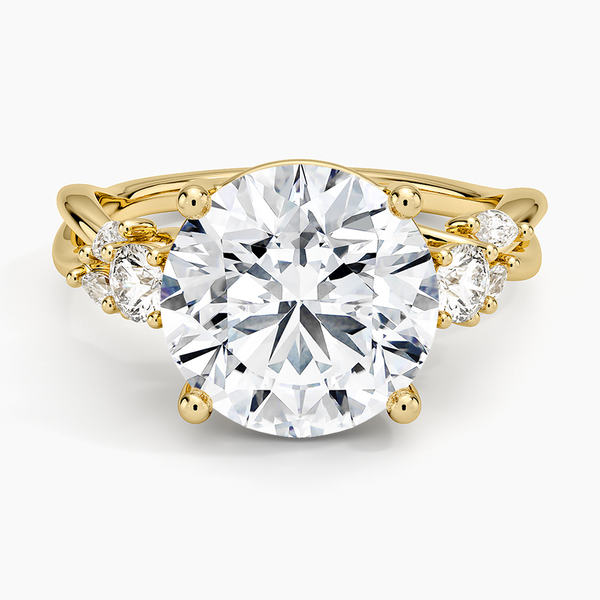
Willow Three Stone Diamond Engagement Ring
£1,574.89

Petite Twisted Vine Hidden Halo Pavé Diamond Engagement Ring
£1,247.29

Willow Ring With Lab Emerald Accents Engagement Ring
£1,221.08

Luxe Willow Sapphire and Diamond Engagement Ring
£1,378.33

Luxe Willow Lab Emerald and Diamond Engagement Ring
£1,378.33

Luxe Secret Garden Lab Emerald and Diamond Engagement Ring
£2,728.04

Secret Garden Lab Emerald and Diamond Engagement Ring
£2,138.36

Petite Luxe Twisted Vine Sapphire and Diamond Engagement Ring
£1,548.68

The Wave Setting
£520.00

The Shore Setting
£690.00

The Tide Setting
£580.00
Designing your ring
Designed online. Made by hand.
The convenience of online design.
-
Visualise it
Detailed CADs from every angle, so you see exactly what we’ll cast.
-
Try before we cast
Free ring sizers and a silver or wax sample to confirm the fit and feel before casting.
-
Hand-finished in London
Cast and finished in our London workshop, fully hallmarked and ready in 7–14 working days.
-
Risk-free
Every stone certified. Free refunds within 30 days (21 working) — no questions asked.
Three steps to your ring
-
1
Choose your starting point
-
2
Pair the two
-
3
We craft & deliver